

You have been here before. A cleaning company presents well in the initial quote. The price seems competitive. The account manager promises consistency, accountability, and a team that will treat your facility like their own. Then the contract starts — and within three months you are chasing missed tasks, dealing with unfamiliar faces on-site, and fielding complaints from your staff about bathrooms that were clearly rushed.
If you are a facility manager or operations manager in Melbourne, this is not bad luck. It is a structural problem in how the commercial cleaning industry sells itself — and how most buyers evaluate vendors.
This blog post is not a sales pitch. It is a practical guide designed to help you identify the warning signs before they become contract headaches. Whether you manage a corporate office, a medical facility, a school, or a strata complex, the process of selecting a commercial cleaning service in Melbourne deserves the same rigour as any other operational procurement decision. The red flags are often hiding in plain sight during the tender process. Knowing where to look is the difference between a long-term, low-maintenance cleaning arrangement and a cycle of provider turnover that costs real time and money.

Why Choosing the Wrong Commercial Cleaner Is More Expensive Than It Looks
Facility managers are typically evaluated on uptime, compliance, and cost control. A poorly chosen cleaning contractor puts all three at risk — yet the cost rarely shows up as a line item until something goes visibly wrong.
Consider what actually happens when cleaning performance degrades in a Melbourne commercial building. Hygiene complaints from staff create workplace culture friction. In office environments, missed high-touch surface disinfection creates infection risk and impacts staff productivity. A contractor with unverified workers on your premises creates liability exposure. An irregular roster means your security protocols are unknowingly compromised every time a different face walks through your front door.
The financial impact compounds quietly. Management time is spent re-briefing cleaners who are unfamiliar with the site. Internal escalation consumes operations resources. Transitioning to a new provider mid-contract involves downtime, onboarding, and the real possibility of repeating the same mistake with a different company.
The real cost of a bad cleaning contract is rarely the monthly invoice. It is the accumulated operational drag — and the risk exposure — that builds underneath.
This is why the vetting process matters before you sign, not after.
The Most Dangerous Red Flags Facility Managers Ignore
These are the warning signs that appear in the sales process, the contract documentation, or the early weeks of service delivery. Most of them are avoidable with the right questions.
1. The Contractor Model — Who Is Actually Cleaning Your Facility?
This is the single most consequential question in commercial cleaning procurement, and the one most buyers forget to ask.
A significant portion of the commercial cleaning industry in Australia operates by subcontracting work to independent operators or labour hire arrangements. On paper, this is not illegal. In practice, it creates a chain of accountability that dissolves the moment something goes wrong.
When a cleaning company uses contractors rather than direct employees, you lose: predictability of the same team on your site, employer-level training standards and oversight, direct accountability when performance drops, and clarity around insurance and workplace injury coverage.
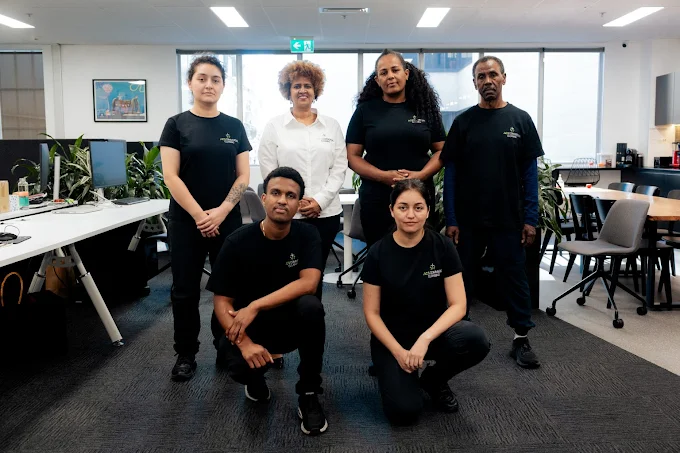
A provider whose staff are directly employed — on payroll, covered by WorkCover, trained and managed in-house — operates with a fundamentally different accountability structure. The quality of their output is their direct commercial liability. That is a meaningful distinction when your WHS obligations depend on who is on your premises and under what conditions.
Before signing any commercial cleaning contract in Melbourne, ask directly: are your cleaners employees or subcontractors? Request documentation if necessary.
2. No Evidence of Public Liability and Workers Compensation Insurance
This one should be straightforward, yet it is routinely overlooked during the excitement of a competitive quote process.
Any commercial cleaning provider operating on your premises in Victoria must hold current public liability insurance — typically a minimum of $20 million — and workers compensation coverage for all staff who enter your site. If a worker is injured on your premises and coverage is inadequate or lapsed, your organisation may carry exposure you were never warned about.
Do not accept verbal assurances. Request certificates of currency, note the expiry dates, and make renewal confirmation part of your annual vendor review. Independent accreditations such as ISO certification are also worth verifying — they signal that the provider’s operational and safety management systems have been independently audited, not just self-declared. If a provider is reluctant to produce this documentation, that reluctance is itself a red flag.
3. High Staff Turnover and Rotating Cleaners
Inconsistency in the cleaning team is one of the most reliable indicators that a provider is under structural strain — whether from poor employment conditions, weak management, or unsustainable pricing.
The operational consequence for your facility is significant. Every new cleaner who arrives on-site requires a period of familiarisation. They do not yet know which areas are highest priority, where the consumables are stored, which surfaces require specific products, or how your security and access procedures work. This learning curve costs quality in the interim.
More importantly, in facilities with heightened security or confidentiality requirements — law firms, financial services businesses, and especially medical and healthcare environments across Melbourne’s commercial precincts — a rotating roster means you have limited visibility into who has access to your premises.
A provider built on stable, long-term employment relationships delivers the opposite of this. Familiar cleaners know your site. They notice things that are out of place. They understand your standards without needing to be re-briefed on every visit. This kind of institutional familiarity is difficult to quantify in a quote, but it is enormously valuable in practice.
4. Vague or Absent Scope Documentation
A professional commercial cleaning company should be able to provide a clear, written cleaning specification for your facility — listing areas, tasks, frequencies, and responsible parties. If the initial engagement produces only a verbal summary or a generic, undifferentiated scope of works, you are already at risk.
Vague scopes produce one predictable outcome: disagreements. When tasks are missed, both parties refer to the contract, and an inadequately specified contract leaves the outcome open to interpretation. The provider argues the task was never agreed. You argue it was implied. Neither position is satisfying when the boardroom bathroom has not been properly cleaned before a client presentation.
During your procurement process, request a detailed site-specific schedule. If the provider has not taken the time to understand your facility before tendering, that is a signal about how they will manage your account after signing.
5. Unrealistically Low Pricing
In commercial cleaning, significantly below-market pricing is almost never sustainable — and the mechanism by which unsustainable pricing adjusts is always at the expense of service quality. Reviewing published commercial cleaning pricing from reputable Melbourne providers gives you a useful benchmark when evaluating quotes.
Low quotes are typically achieved through some combination of underpaying staff, reducing cleaning time on-site, skipping consumables costs, or using unqualified subcontractors who accept lower rates because they have no alternative. None of these compromises are visible at quote stage. All of them appear in service delivery.
The Award wage obligations under the Cleaning Services Award 2020 set a floor for what legitimate operators must pay their employees. Providers quoting significantly below market are either operating with considerable margin pressure, cutting staffing hours, or — in the most concerning cases — not fully complying with employment obligations. Any of these scenarios creates downstream risk for your facility.
Competitive pricing is reasonable and should be expected. Suspiciously cheap pricing should prompt detailed questions about staffing ratios, cleaning hours per visit, and employment structure.
6. No Quality Assurance or Accountability Systems
A cleaning company operating at a professional standard in Melbourne’s commercial environment should have documented processes for quality checking — whether that is supervisory inspections, client feedback mechanisms, digital reporting tools, or scheduled review meetings.
If a provider cannot explain how they identify and remedy underperformance before a client complaint is raised, there is no accountability loop. Issues are only escalated when you notice them — which means the standard is reactive rather than managed.
Ask specifically: How do you monitor quality between client contact points? What happens when a cleaner calls in sick — is there a documented backup protocol? Who is the escalation point if I have a service concern at 6 AM? The answers reveal how operationally mature the organisation actually is.
7. Weak Communication and Poor Responsiveness Pre-Contract
This one is often dismissed as subjective, but it is a reliable predictor of how a provider will behave once they have your signature.
If proposal responses are slow, follow-up calls go unreturned, or the initial site assessment feels perfunctory, you are observing real operational culture — not a temporary sales lapse. Providers who invest heavily in winning business before a contract is signed but treat account management as a lower priority afterwards are common in this industry.
Conversely, a provider who is direct about pricing, transparent about their staffing model, and willing to discuss their limitations alongside their strengths is demonstrating the kind of commercial integrity that builds durable service relationships.
The Hidden Cost of Choosing the Cheapest Quote
Let us quantify this more concretely. A Melbourne-based facility manager managing a 2,000 square metre commercial office space selects a cleaning provider on the basis of a quote that is $180 per month cheaper than the next competitor.
Over 12 months, that is a $2,160 saving on paper.
However, within six months: the cleaning team has changed three times, consuming approximately five hours of management time across inductions and briefings. Two formal complaints from staff have required investigation and response. One missed deep clean of the kitchen area has resulted in a pest control call-out. And the facility manager is now mid-process in moving to a new provider, which involves legal review of the termination clause and a four-week transition period with degraded service.
The actual cost differential, once management time, reactive remediation, and transition costs are factored in, has long surpassed the original saving. The cheaper quote was not cheap.
Price is a factor in vendor selection. It should not be the primary filter when the downstream risks are this concrete.
What Professional Commercial Cleaning Actually Looks Like
The benchmark for professional commercial cleaning in Melbourne is not defined by marketing language. It is defined by operational structure, employment practices, and the presence of systems that ensure consistent outcomes without requiring constant client oversight.
A professionally run commercial cleaning operation deploys the same trained employees to the same sites on a consistent schedule — not because it is a nice thing to do, but because familiarity with a site is directly correlated with cleaning quality. Cleaners who know your facility know your standards, understand your access requirements, and take ownership of outcomes in a way that a rotating contractor workforce simply cannot replicate.
Professional providers invest in quality management infrastructure. This might include supervisory site audits, digital task verification, regular client communication touchpoints, and documented protocols for managing absences, emergencies, or scope changes. These systems cost money to build and maintain — which is one reason why genuinely professional providers rarely offer the lowest quote in a tender.
ISO certification is one credible signal of operational maturity. ISO 9001:2015 (quality management), ISO 14001:2015 (environmental management), and ISO 45001:2018 (occupational health and safety) certifications demonstrate that a provider has undergone independent verification of their management systems — not just their sales messaging. In an industry where claims are easy to make and hard to verify, third-party certification carries real weight.
Professional providers are also transparent about pricing from the outset. Facility managers dealing with concealed costs — charges for consumables that were implied as included, overtime rates for tasks that were always on the scope, fee adjustments after the first month — are dealing with a provider whose commercial model depends on information asymmetry. That is not a long-term partnership.
Vendor Vetting Checklist for Facility Managers
Use this as a structured reference during your next commercial cleaning tender in Melbourne. Every reputable provider should be able to answer these questions clearly and without hesitation.
| Question to Ask | Why It Matters |
| Are your cleaning staff directly employed or subcontracted? | Employment model determines accountability, insurance coverage, and training standards. |
| Can you provide current certificates of insurance — public liability and workers compensation? | Confirms that your premises exposure is covered. Request originals, not photocopies. |
| How do you handle staff absence? Is there a documented backup protocol? | Reveals operational depth. A yes with no detail is not a satisfactory answer. |
| Will we have the same core team assigned to our site? | Team consistency is a direct indicator of service continuity and site familiarity. |
| Can you provide a site-specific cleaning specification before the contract is signed? | Vague scopes produce disputes. Specificity signals operational professionalism. |
| How is quality monitored between client-reported issues? | Proactive quality assurance distinguishes managed services from reactive ones. |
| What is your staff training process and how is it documented? | Training depth determines whether standards are maintained or assumed. |
| What are your payment terms and are there any costs not covered in the quoted scope? | Transparent pricing eliminates the most common source of client-provider conflict. |
| What does your transition process look like — how do you onboard a new client site? | Structured onboarding reflects experience with commercial environments. |
| Do you hold any independent certifications or third-party quality accreditations? | ISO certification or equivalent signals verifiable operational investment. |
A provider who handles this list with confidence, specificity, and without defensiveness is demonstrating the kind of operational transparency that reduces procurement risk.
Why Melbourne Businesses Are Raising Their Standards
The commercial property landscape across Melbourne — from the Docklands and CBD commercial towers to South Melbourne’s professional services precincts and the eastern and northern industrial corridors — has become more demanding of cleaning partners in recent years. Several converging factors explain this shift.
Post-pandemic hygiene expectations in shared commercial environments have not returned to pre-2020 norms. Staff in Melbourne offices are more attuned to surface hygiene, air quality, and the visible condition of amenities than they were five years ago. For facility managers, the cleaning program is now a more visible part of the employee experience conversation — and underperformance is noticed faster.
The growth of hybrid work patterns means that Melbourne office spaces are hosting more high-density days — team days, client visits, all-hands meetings — where the appearance and hygiene condition of the facility carries reputational weight. An inconsistent cleaning standard that was tolerable when the office was half-occupied becomes obvious when the full team is in and clients are present.
Regulatory compliance requirements in industries like childcare, aged care, schools, food service, and healthcare have also intensified. Cleaning providers working across these environments in Melbourne need demonstrable capability in infection control protocols, appropriate chemical management, and documentation of cleaning records — not just general cleaning competence.
The businesses raising the bar are not simply paying more. They are making more structured vendor selection decisions — treating cleaning providers with the same procurement rigour applied to other operational service contracts.
How to Choose a Long-Term Commercial Cleaning Partner
The distinction between a cleaning vendor and a cleaning partner is operational, not semantic.
A vendor delivers a service to a specification. A partner understands your facility’s operating rhythm, anticipates changes in requirements, communicates proactively when issues arise, and manages their own performance without requiring constant supervision from your team.
Finding that kind of relationship starts with selecting a provider whose organisational model is oriented toward long-term arrangements rather than high-volume client churn. There are structural signals you can look for.
Owner involvement in client service — where the business principal maintains direct accountability for the quality of accounts rather than delegating all client contact to a sales team — is one such signal. When the person who built the business is reachable and invested in your account, the level of care tends to be qualitatively different from a large impersonal operation where individual clients are line items.
Willingness to back service quality with a formal guarantee is another. A 30-day money-back guarantee, for example, is not a marketing gimmick when it is genuinely offered — it is a structural signal that the provider is confident in their ability to deliver what they have promised. Providers who are uncertain of their own performance rarely offer this kind of commitment.
Consider the longevity of the provider’s existing client relationships. If a cleaning company has maintained multi-year relationships with Melbourne businesses across corporate offices, medical facilities, and specialised environments, that retention record is a more reliable indicator of quality than any brochure claim. Reading verified client reviews is one of the most direct ways to assess whether a provider’s service delivery matches their sales narrative.
Finally, consider whether the provider’s service model is designed around your facility’s needs or around their operational convenience. A genuinely client-oriented commercial cleaner will invest in understanding your site before they begin — conducting a thorough assessment, documenting your specific requirements, and building a scope that reflects your actual facility rather than a templated assumption.
The Facility Manager’s Responsibility in This Process
Choosing a commercial cleaning provider is not a passive exercise. The risks outlined in this article are real, but they are largely preventable with a structured approach to vendor selection.
Use the checklist above. Ask the hard questions before you sign. Request documentation, not assurances. Look past the lowest quote to understand the staffing model and operational infrastructure behind it. Check that insurance is current. Confirm that the people cleaning your facility are direct employees — with real accountability to the organisation you are contracted with.
When you find a provider who answers every question with transparency, who can demonstrate operational depth through certifications and documented processes, and who is willing to back their service with a genuine performance commitment — that is the provider worth investing in for the long term.
Melbourne’s commercial cleaning market is large and varied. The providers who will still be delivering excellent service to your facility in three years are identifiable today — if you know what to look for.
If you manage a commercial facility in Melbourne and would like to discuss a cleaning arrangement built on direct employment, transparent pricing, and consistent teams, ACS Commercial Cleaning offers a complimentary site consultation and transparent quote with no obligation. Explore our full range of commercial cleaning services, learn more about our ISO-certified approach, or contact us to arrange a site visit.

