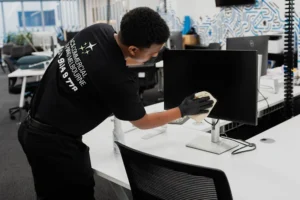
Daily office cleaning is the right choice for offices with 25+ staff, high visitor traffic, shared kitchens or bathrooms, or client-facing reception areas. Weekly office cleaning suits offices with fewer than 15 staff, private-office layouts, hybrid or low-occupancy schedules, or strict budget constraints. Most Melbourne offices land in the middle — and the most cost-effective model in 2026 is a hybrid schedule: daily service for restrooms, kitchens and high-touch surfaces, combined with 2–3× weekly cleaning for workstations and full-floor attention. This approach typically reduces cleaning spend by 20–30% compared to uniform daily service while maintaining the same hygiene outcomes.
The Quick Answer (For the Decision-Maker in a Hurry)
If you’re an office manager or facility manager trying to decide between daily and weekly cleaning, the decision comes down to five variables: headcount, traffic, layout, industry, and occupancy pattern. Get those five right, and your cleaning schedule designs itself.
- Choose daily cleaning if you have 25+ staff, shared amenities, client-facing areas, or industry-specific hygiene obligations (medical, legal, food-adjacent).
- Choose weekly cleaning if you have fewer than 15 staff, low visitor traffic, private offices, and a hybrid workforce in-office only 2–3 days a week.
- Choose a hybrid schedule — daily touch-points + 2–3× weekly full cleaning — if you’re between these two profiles. This is what the majority of Melbourne offices should actually be running, and most aren’t.
The rest of this guide shows you how to make the decision properly, how to cost it honestly, and how to avoid the two most common mistakes Melbourne office managers make when they get this wrong.
Why Cleaning Frequency is the Most Under-Considered Decision in Facility Management
Most Melbourne offices inherit their cleaning schedule. Nobody designed it. The previous office manager agreed to a five-nights-a-week contract in 2019, the business moved offices, the hybrid era arrived, headcount halved, and the same schedule still runs in 2026 — costing money it shouldn’t and cleaning floors nobody sat at.
The reverse also happens. A small office signs a weekly contract to save money. Headcount grows. Client visits pick up. The bathroom starts to look tired by mid-week. Google reviews start mentioning the smell of the kitchen. By the time the office manager notices, the weekly schedule has quietly been underperforming for six months.
Cleaning frequency isn’t a set-and-forget decision. It’s the operational lever that determines:
- Whether your staff take fewer sick days
- Whether clients form a positive first impression in reception
- Whether your carpets, upholstery and fit-out have a five-year or ten-year service life
- Whether your cleaning spend is 30% over-scoped or 30% under-scoped
- Whether your cleaner is actually solving your hygiene problem or just moving dust around
At ACS, every new client onboarding starts with a frequency audit — not a quote. The quote is downstream of the frequency matrix. That’s the methodology this guide walks through.
Daily vs Weekly Office Cleaning: The Direct Comparison
Here is the side-by-side comparison that most competitor articles bury halfway down the page. It’s the first thing you need.
| Factor | Daily Office Cleaning | Weekly Office Cleaning |
|---|---|---|
| Typical visit frequency | 5–7 visits per week | 1 visit per week |
| Best for office size | 25+ staff, 250m²+ | ≤15 staff, ≤150m² |
| Best for traffic level | High — regular visitors, client meetings | Low — mostly internal team |
| Typical Melbourne cost (standard office) | $600–$1,200 per week | $180–$400 per week |
| Hygiene outcome | Consistently high across all zones | High on cleaning day, declining through the week |
| Kitchen/bathroom condition | Maintained daily | Can deteriorate by Wed–Thu in busy offices |
| High-touch surface sanitation | Daily disinfection of door handles, EFTPOS, switches | Once per week |
| Impact on sick-day absenteeism | Material reduction (proactive hygiene) | Limited (reactive hygiene) |
| Bin and waste management | Daily emptying | Weekly — odour risk in kitchens/bathrooms |
| Carpet and fit-out wear | Reduced through daily soil removal | Faster wear; more frequent deep cleans needed |
| Client/visitor impression | Consistently professional | Risk of under-presentation mid-week |
| Suitability for hybrid workforce | Over-scoped if office is half-empty 3 days a week | Well-matched to 2–3 day in-office patterns |
| Compliance for medical/legal/food-adjacent | Appropriate | Insufficient |
| Typical contract term | 12-month (often with discount) | 6–12 month |
| When to avoid | <15 staff + hybrid workforce + private offices | 25+ staff, shared amenities, client-facing |
The takeaway from this table isn’t “pick one.” It’s that these are two ends of a spectrum, and most Melbourne offices belong somewhere in the middle.
What’s Actually Done in a Daily Office Clean
A typical Melbourne daily office clean runs between 60 and 180 minutes depending on office size, performed after hours (usually 6pm–10pm or 5am–7am). The scope covers:
- Reception and entry — glass doors, reception desk, visitor chairs, waiting area
- Workstations — desk wipe-down (where clear), chair base, phone, monitor edges
- Kitchen and breakout — bench wipe-down, sink clean, dishwasher load/unload (where agreed), bin empty, floor mop
- Bathrooms and amenities — toilets, sinks, mirrors, floor mop, consumable restock
- Meeting rooms — table wipe, chair reset, whiteboard clean, AV surfaces
- High-touch surfaces — door handles, light switches, lift buttons, EFTPOS, printer touch-panels
- Floors — vacuum carpets, mop hard floors in circulation areas
- Waste — all bins emptied, liners replaced, external waste placed for collection
Daily cleaning is a maintenance cycle. Each visit is relatively light because the office never becomes substantially dirty between visits. The cumulative effect is consistency — the office looks the same on Monday morning as it does on Friday afternoon.
What’s Actually Done in a Weekly Office Clean
A typical weekly office clean runs between 90 and 240 minutes and is more intensive than any individual daily visit. Scope typically covers:
- Full floor clean — comprehensive vacuuming, mopping, and edge detail
- All workstations — full wipe-down, screen and keyboard clean
- Complete kitchen reset — bench, splashback, appliance exteriors, sink scrub, bin clean and reline, fridge exterior
- Bathroom deep clean — grout attention, fixture descale, sanitary bin servicing, full restock
- Meeting rooms and boardrooms — table polish, chair clean, AV cleaning, whiteboard deep clean
- All high-touch surfaces — full round including less-touched zones (skirting, window sills, door frames)
- Common areas and corridors — full clean including edges and corners
- Internal glass — partitions, door panels, reception glass
- Periodic elements — rotating tasks like vent dusting, skirting clean, light-fitting dust
Weekly cleaning is a reset cycle. The office is substantially dirtier before the clean and substantially cleaner after. The hygiene curve looks very different from daily cleaning — a sharp lift on cleaning day, then gradual decline through the week.
The Hygiene Curve: What Actually Happens Between Cleans
This is the section missing from every competitor article on this topic. The difference between daily and weekly cleaning is not just frequency — it’s what happens to surface hygiene between cleans.
On a surface like a bathroom door handle, kitchen tap, EFTPOS terminal, or shared keyboard, bacterial load builds progressively between cleans. US CDC guidance and ISSA Clean Standards both recognise that high-touch surface hygiene is materially outperformed by cleaning frequency, not by cleaning intensity. A surface disinfected once per week and then touched hundreds of times before the next clean is biologically closer to “not cleaned” by Thursday than most office managers realise.
Practical implication: for any shared, high-touch, or wet-area surface, daily cleaning isn’t a luxury — it’s the hygiene floor. For workstations, private offices, storage areas and seldom-used rooms, weekly cleaning is often more than sufficient.
This is why the hybrid model works so well. It applies the right frequency to the right zones, instead of applying a single frequency across the whole office.
The Hybrid Model: How Smart Melbourne Offices Actually Schedule Cleaning in 2026
The highest-performing office cleaning contracts in Melbourne right now don’t pick daily or weekly. They pick both — applied to different zones.
The zoning principle: define three cleaning zones, assign a frequency to each, and build the contract around the combined scope. This typically delivers the hygiene outcome of daily cleaning at 70–80% of the cost.
Zone A — Daily (or Twice Daily for High Traffic)
- Bathrooms and amenities
- Kitchen and breakout areas
- Reception and visitor areas
- High-touch surfaces (door handles, lift buttons, EFTPOS, switches, printer panels)
- Waste bins in shared areas
- Entry glass
Zone B — 2–3× Weekly
- Open workstations
- Conference rooms and meeting rooms
- Hard-floor mopping and carpet vacuuming in circulation areas
- Internal glass and partitions
- Common areas
Zone C — Weekly
- Private offices
- Storage rooms, archive rooms
- Rarely-used meeting rooms
- Skirtings, window sills, vents (rotating)
- Detail dusting of fixtures
Zone D — Periodic
- Carpet steam cleaning (quarterly)
- Upholstery clean (bi-annual)
- Internal window clean (monthly)
- External window clean (quarterly)
- HVAC vent clean (annual or as triggered)
The hybrid approach is what Hannah builds into almost every ACS office cleaning program — because it matches spend to actual need rather than defaulting to either extreme.
Cost Comparison: Daily vs Weekly Office Cleaning in Melbourne (2026)
Honest pricing, based on current Melbourne market rates and ACS contract data. Offices with medical, legal or food-service elements typically sit at the top of each range.
| Office Profile | Daily Cleaning (5 nights/week) | Weekly Cleaning (1 night/week) | Hybrid (Recommended) |
|---|---|---|---|
| Small office (up to 100m², ≤10 staff) | $350–$550/week | $120–$220/week | $220–$380/week (2× weekly + daily kitchen/bath touch) |
| Small-medium (100–200m², 10–25 staff) | $500–$850/week | $180–$320/week | $320–$580/week |
| Medium (200–500m², 25–60 staff) | $850–$1,600/week | $280–$500/week | $600–$1,100/week |
| Large (500–1,000m², 60–150 staff) | $1,600–$3,200/week | $500–$900/week | $1,100–$2,200/week |
| Corporate floor (1,000m²+) | $3,200–$6,500+/week | Not recommended | $2,200–$4,800+/week |
Key cost signals to understand:
- Melbourne office cleaning hourly rates run $45–$70 per hour in 2026 for compliant, insured, ISO-certified operators. Rates below $40/hour are almost always a subcontractor model where cleaners are paid below award rates — a significant supply-chain risk and a strong predictor of service decline within 6 months.
- After-hours penalty rates add 10–15% to standard rates under the Cleaning Services Award MA000022, but most Melbourne office cleaning is performed after hours by necessity.
- Annual contracts typically unlock 10–20% savings compared to month-to-month engagements.
- Hybrid scheduling typically saves 20–30% compared to uniform daily cleaning with no hygiene compromise.
- Consumables (soap, hand towels, bin liners, toilet paper) are typically charged at cost + 10% or included in contract depending on scope.
When Daily Office Cleaning is the Right Decision
Daily cleaning is the right call — not a luxury — when any of the following apply:
- Staff headcount above 25 with shared workspaces
- High visitor and client traffic through reception and meeting rooms
- Client-facing brand perception matters — legal, professional services, consulting, finance
- Shared bathrooms and kitchens that serve the full office
- Hot-desking or shared-desk layouts where surface hygiene is a health concern
- Industry compliance — medical centres, dental clinics, allied health, food-adjacent businesses, childcare-adjacent
- Multi-level corporate floors where a single daily reset maintains presentation across zones
- Flu season or respiratory illness peaks (Victorian winter months — May through September)
- Post-incident environments — after construction, after staff illness outbreaks, after events
In these cases, weekly cleaning will predictably underperform. The hygiene curve falls below an acceptable floor by mid-week and the office manager ends up chasing problems rather than preventing them.
When Weekly Office Cleaning is the Right Decision
Weekly cleaning is the right call when:
- Staff headcount is 15 or fewer and growth is flat
- Hybrid workforce — majority of staff work from home 3+ days per week
- Low visitor traffic — mostly internal team, rarely client-facing
- Private office layouts with minimal shared surfaces
- No shared kitchen or bathroom (each tenant has separate amenities)
- Budget-constrained small business where cleaning is a variable cost, not a fixed one
- Seasonal or project-based workforce with predictable low-occupancy windows
For offices in this profile, a well-scoped weekly clean supported by a self-managed high-touch wipe routine (staff-led Friday afternoon kitchen tidy, weekly bathroom quick-check) is perfectly adequate.
When the Hybrid Model Wins (Most Melbourne Offices)
The hybrid model is the right choice when:
- Staff headcount is 15–60
- Office runs a hybrid workforce with peak days (typically Tuesday–Thursday in Melbourne CBD)
- Some client traffic — occasional visitors, not constant
- Shared bathroom and kitchen but not heavy-traffic
- Mixed layout — some open plan, some private offices
- Moderate industry hygiene standards — professional services, tech, creative agencies, non-healthcare
- Cost efficiency matters but cleanliness cannot be compromised
This profile describes the majority of Melbourne offices in 2026. It’s also the profile most likely to be over-paying on a legacy daily contract designed before the hybrid era.
The Five-Question Frequency Audit (Run This on Your Office Today)
Before accepting a quote or renewing a contract, answer these five questions. Each one moves your answer along the daily-hybrid-weekly spectrum.
1. How many staff occupy the office on a typical Tuesday, Wednesday or Thursday (peak days)?
- Fewer than 10 → leans weekly
- 10–25 → leans hybrid
- 25–60 → strongly hybrid or daily
- 60+ → daily, with potential day-porter coverage
2. How many external visitors walk through reception per week?
- 0–5 → weekly or hybrid
- 5–25 → hybrid
- 25+ → daily
3. Do multiple staff share the same bathroom and kitchen?
- No (private amenities) → weekly feasible
- Yes (shared) → daily touch-point cleaning required regardless of other scope
4. Does your industry carry statutory hygiene expectations?
- Medical, dental, allied health, childcare, food-adjacent → daily minimum
- Legal, finance, professional services with client visits → daily or hybrid
- Internal creative, tech, consulting → hybrid or weekly
5. What does your occupancy pattern look like Mondays and Fridays?
- Full office (near-capacity) → daily likely
- Reduced occupancy → hybrid (skip low-days for some zones)
- Empty on Mondays and/or Fridays (typical hybrid) → hybrid, concentrated on peak days
If your answers cluster toward the daily end, you likely need daily. If they cluster toward the weekly end, weekly is fine. If they’re mixed — which they are for most Melbourne offices — the hybrid model is your answer.
Daily vs Weekly Office Cleaning Checklist (Task-Level Comparison)
| Task | Typical Daily Schedule | Typical Weekly Schedule | Recommended Actual Frequency |
|---|---|---|---|
| Empty waste bins | Every visit | Every visit | Daily minimum (shared areas) |
| Restock bathroom consumables | Every visit | Every visit | Daily check |
| Disinfect toilets, urinals, sinks | Every visit | Every visit | Daily |
| Disinfect kitchen benches and sinks | Every visit | Every visit | Daily |
| Wipe high-touch surfaces (handles, switches) | Every visit | Every visit | Daily |
| Vacuum carpeted circulation areas | Every visit | Weekly | 2–3× weekly (minimum) |
| Mop hard floors | Every visit | Weekly | 2–3× weekly (minimum) |
| Wipe all workstations | Every visit (where clear) | Weekly | Weekly sufficient |
| Clean meeting room tables | Every visit | Weekly | 2–3× weekly |
| Internal glass and partitions | Rotating | Weekly | Weekly |
| Skirting boards, window sills detail | Rotating | Rotating | Fortnightly–monthly |
| Appliance exteriors (fridge, microwave, dishwasher) | Weekly within daily | Every visit | Weekly |
| Descale kitchen tap and bathroom fixtures | Weekly | Monthly | Monthly minimum |
| Carpet steam clean | Quarterly | Quarterly | Quarterly |
| Upholstery deep clean | Bi-annual | Bi-annual | Bi-annual |
| Internal window clean | Monthly | Monthly | Monthly |
| Vent and light-fitting dust | Rotating | Rotating | Quarterly |
The “recommended actual frequency” column reflects what Hannah builds into ACS contracts after frequency audits. It’s frequently different from what clients inherit from previous providers.
Productivity, Sick Days and the ROI of Cleaning Frequency
Cleaning frequency has a measurable effect on workplace absenteeism, and it’s a larger effect than most office managers realise. Research published by the International Facility Management Association (IFMA), US CDC surface hygiene guidance, and multiple studies on office absenteeism consistently point to the same pattern:
- Offices with daily disinfection of high-touch surfaces see materially lower rates of respiratory illness transmission across winter months
- Shared keyboards, phones, EFTPOS terminals and kitchen surfaces are the primary transmission vectors in offices
- Weekly-only cleaning in high-density offices allows pathogen load to build to levels that influence illness spread by mid-week
The rough economics:
- Average cost of one sick day in Australia: ~$340 in lost productivity (Safe Work Australia / Productivity Commission estimates)
- A 60-person office saving even two sick days per month through better hygiene recovers $8,160 per year in productivity
- That figure alone typically funds the hybrid model upgrade over uniform weekly cleaning
This is the ROI calculation that rarely appears in cleaning proposals but materially drives the decision.
The Two Most Expensive Mistakes Melbourne Office Managers Make
Mistake 1: Under-Scoping the Contract
Signing a weekly-only cleaning contract for an office that needs daily attention to restrooms and kitchens. The contract looks cheap on paper. Six months in, you’ve received three complaints about the bathroom, two negative Google reviews mentioning cleanliness, and you’re secretly buying supermarket cleaning spray for staff to use between cleans. The hidden cost of under-scoping is the management overhead of continually chasing the gap.
Fix: Run the five-question audit. If you end up at “hybrid” or “daily” and your contract is weekly-only, renegotiate scope, not provider (at first).
Mistake 2: Over-Scoping the Contract
Paying for five-night-a-week cleaning on an office that runs at 40% occupancy three days a week. You’re cleaning empty floors on Mondays and Fridays. The difference between what you pay and what you actually need is usually 25–40% of the contract value.
Fix: Shift to a hybrid model. Keep daily frequency on bathrooms, kitchens and high-touch surfaces. Drop full-office cleaning to 2–3 times per week on peak days. Apply the savings to a quarterly deep clean and a carpet steam cycle.
Getting this right is the single biggest cost-efficiency win available to most Melbourne office managers in 2026.
Why ACS Structures Cleaning Schedules Differently
Most commercial cleaners in Melbourne sell you a schedule. ACS builds you one.
Every new ACS office client goes through a frequency audit with Hannah Kasay, our CEO, personally. The audit walks your office, maps your zones, reviews your occupancy pattern, and produces a zone-by-zone frequency matrix before any quote is issued. The quote is downstream of the frequency design — not a line-item default.
This matters for three reasons:
- You stop paying for cleaning you don’t need. Most legacy daily contracts are over-scoped in 2026 post-hybrid conditions.
- You stop under-cleaning zones that matter. Most weekly contracts under-cover bathrooms and kitchens in offices that actually need daily touch-points.
- The schedule gets reviewed every 6 months. Headcount changes, occupancy changes, client patterns change. Cleaning frequency should change with them.
ACS is triple ISO certified (ISO 9001 Quality, ISO 14001 Environmental, ISO 45001 OH&S), operates under a Victorian Labour Hire Licence (VICLHLO6255), employs every cleaner directly (no subcontractors), and assigns a dedicated team to every office. Every contract carries a 30-day service guarantee.
When the CEO of your cleaning company is the person who designed your schedule — and is still the person you can call when something needs adjusting — the incentive structure of the entire relationship changes.
Book a Frequency Audit (Not a Quote)
If you’re about to sign a new office cleaning contract, renew an existing one, or just suspect you’re over-paying on a legacy schedule, the right first step isn’t a quote — it’s a frequency audit.
Hannah personally runs a 30-minute on-site walkthrough, maps your zones, reviews your occupancy pattern, and produces a zone-based schedule matched to your actual office. No obligation, no hard sell. Just an honest analysis of whether you should be on daily, weekly, or hybrid — and what it should cost.
Book a frequency audit → On-site walkthrough or call (03) 9114 9778.
FAQ
How often should an office be cleaned?
Most Melbourne offices should be cleaned on a zone-based hybrid frequency: daily cleaning for bathrooms, kitchens, reception and high-touch surfaces; 2–3 times weekly for workstations and circulation areas; weekly for private offices and low-use rooms; and periodic (quarterly–bi-annual) for deep-clean elements. Uniform daily or uniform weekly cleaning is almost always either over-scoped or under-scoped. The correct frequency depends on staff headcount, visitor traffic, layout, industry, and occupancy pattern.
Is daily office cleaning necessary?
Daily office cleaning is necessary when you have 25+ staff, shared bathrooms and kitchens, client-facing reception, or industry-specific hygiene requirements (medical, dental, allied health, childcare, food-adjacent). For offices with fewer than 15 staff, hybrid workforces, or private-office layouts, uniform daily cleaning is typically over-scoped by 20–40%. In those cases, a hybrid schedule (daily for high-touch zones, 2–3× weekly for general areas) delivers the same hygiene outcome at significantly lower cost.
How much does weekly office cleaning cost in Melbourne?
In 2026, weekly office cleaning in Melbourne costs approximately $120–$220 per week for small offices (under 100m²), $180–$320 for small-medium offices (100–200m²), $280–$500 for medium offices (200–500m²), and $500–$900 for large offices (500–1,000m²). Rates below $40 per hour usually indicate a subcontractor model with sub-award wages — a structural risk that correlates with service failure within 6–12 months. Annual contracts typically unlock 10–20% savings over month-to-month engagements.
How much does daily office cleaning cost in Melbourne?
Daily office cleaning (5 nights per week) in Melbourne typically costs $350–$550 per week for small offices, $500–$850 for small-medium, $850–$1,600 for medium offices, and $1,600–$3,200+ for large offices. Daily contracts command the lowest per-visit rates because cumulative cleaning per visit is lighter. Most Melbourne daily contracts signed before 2022 are now over-scoped due to hybrid-era occupancy patterns, and can be restructured into hybrid schedules for 20–30% savings.
What’s the difference between daily and weekly office cleaning?
Daily office cleaning is a maintenance cycle — lighter visits 5–7 times per week that keep the office at a consistent hygiene level. Weekly office cleaning is a reset cycle — one intensive visit per week that returns the office to clean, with gradual decline through the week. The hygiene curve is flatter with daily cleaning and higher-variance with weekly cleaning. The critical operational difference: high-touch surfaces (door handles, EFTPOS, kitchen benches, bathroom fixtures) perform much better under daily cleaning regardless of office size.
Can I split daily and weekly cleaning across different areas?
Yes — and this is the recommended model for most Melbourne offices. The hybrid schedule applies daily cleaning to high-touch zones (bathrooms, kitchens, reception, door handles, EFTPOS, switches), 2–3 times weekly to workstations and circulation areas, and weekly to private offices and low-use rooms. This zone-based approach typically reduces cleaning costs by 20–30% compared to uniform daily cleaning with no hygiene compromise.
How often should office bathrooms be cleaned?
Office bathrooms should be cleaned and disinfected at least daily in any office with more than five staff, regardless of the rest of the cleaning schedule. In offices with 30+ staff, heavy visitor traffic, or shared multi-tenant bathrooms, twice-daily servicing during operating hours is often required to maintain consumables and hygiene standards. Weekly-only bathroom cleaning is almost never appropriate for shared facilities and is a leading cause of cleanliness-related staff and visitor complaints.
How often should office kitchens and breakout areas be cleaned?
Office kitchens and breakout areas should be cleaned daily in any shared-kitchen office, including bench wipe-down, sink clean, bin empty, and floor mop. Weekly-only kitchen cleaning creates odour and hygiene risks by mid-week and is one of the most common causes of staff complaints. Dishwasher cycles, fridge exteriors and appliance detail are typically scheduled weekly within a daily or hybrid contract. Fridge interiors should be cleaned monthly with staff-notified clear-out.
Does hybrid work change the right office cleaning frequency?
Yes, substantially. Hybrid work has made most pre-2022 daily cleaning contracts over-scoped by 20–40%. In 2026, the most cost-effective approach for hybrid offices is to concentrate cleaning on peak occupancy days (typically Tuesday, Wednesday and Thursday in Melbourne CBD), reduce full-office cleaning on low-occupancy days, and maintain daily frequency only on shared amenities (bathrooms, kitchens) where consumable replenishment and hygiene cannot drop. Most legacy daily contracts benefit from a frequency audit.
Does more frequent cleaning actually reduce staff sick days?
Yes — and the effect is measurable. Daily disinfection of high-touch surfaces (door handles, EFTPOS, shared keyboards, kitchen benches) reduces transmission of respiratory and gastrointestinal illness in offices. The primary transmission vectors in shared office environments are high-touch surfaces, not airborne alone. Industry estimates place the average cost of one Australian sick day at approximately $340 in lost productivity. A 60-person office saving even two sick days per month through improved surface hygiene recovers ~$8,160 per year — typically enough to justify a hybrid model upgrade over weekly-only cleaning.
What’s the best office cleaning schedule for a small business in Melbourne?
The best office cleaning schedule for a small Melbourne business (5–20 staff) is typically a hybrid model: 2–3 weekly cleans covering the full office, plus daily 15-minute touch-point visits covering bathrooms, kitchen and waste bins. This delivers the hygiene outcome of daily cleaning at 50–60% of the cost. Pure weekly cleaning works for offices under 10 staff with private amenities and a hybrid workforce. Pure daily cleaning is almost always over-scoped at small-business scale unless the business is medical, food-adjacent, or client-facing.
Written by Hannah Kasay, CEO — ACS Commercial Cleaning