
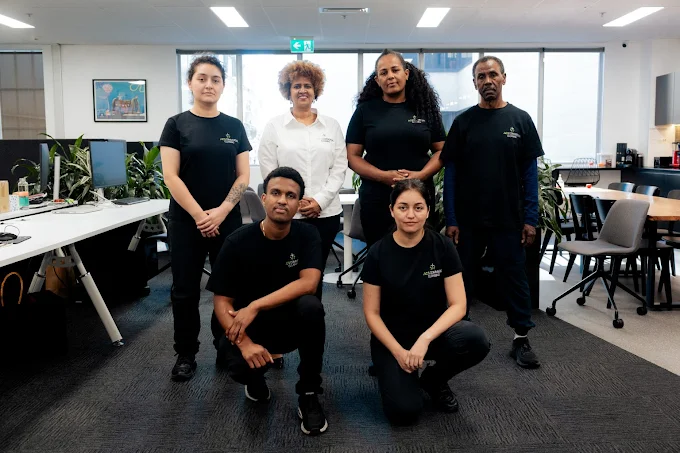

A commercial cleaning company in Melbourne is a B2B service provider that delivers scheduled, contracted cleaning to offices, medical centres, industrial facilities and commercial properties — typically under a long-term service agreement. The best providers use directly employed cleaners (not subcontractors), assign the same dedicated team to each site for consistency, hold ISO certifications for quality and safety, and are structured around a single point of accountability so issues are resolved in hours, not weeks.
The Problem Most Melbourne Businesses Only Discover After Signing
Most facility managers, office managers and property managers don’t switch cleaning companies because they want to. They switch because they’ve lived through the same pattern three or four times:
The contract starts strong. Within eight weeks, the cleaners have rotated. Communication goes through a call centre. Tasks get missed. Nobody escalates. By month six, the office manager is taking photos of skipped bins at 7am and chasing a scheduler who wasn’t there when the contract was signed.
The cleaning industry in Australia has a structural problem — and most buyers only learn about it after they’ve already signed a twelve-month agreement. The industry has been flagged repeatedly by the Fair Work Ombudsman and the Cleaning Accountability Framework for sham contracting, underpayment, and layered subcontracting models where the company you pay is rarely the company doing the work.
At ACS Commercial Cleaning, we’ve built the opposite model. Every ACS cleaner is a direct W2 employee. Every site is assigned a dedicated team. And every client relationship runs through the same line of accountability — our CEO, Hannah Kasay, who is personally involved from onboarding through to ongoing service delivery.
This guide explains what a genuinely reliable commercial cleaning partner looks like in Melbourne in 2026, what separates structured B2B operators from the industry’s default (disconnected, subcontracted, call-centre-run), and what to ask before you commit to a contract.
Why Choosing the Right Commercial Cleaning Partner Actually Matters
The cost of a poor cleaning contract is never just the monthly invoice. It’s:
- Staff experience. A consistently poorly cleaned office silently erodes culture. People notice overflowing bins and sticky kitchens long before they raise them.
- Client perception. For legal chambers, medical suites, strata lobbies and client-facing offices, cleanliness is a direct brand signal. A dirty reception is a dirty business.
- Compliance risk. Medical centres, childcare facilities, aged care sites and food-adjacent businesses carry statutory cleaning obligations. A cleaner who missed three nights last month isn’t a scheduling issue — it’s an audit risk.
- Management overhead. The real cost of a bad cleaning provider is the hours your facility manager spends chasing it. That’s the hidden line item nobody prices into the original quote.
A structured commercial cleaning partnership eliminates these risks at the source. A transactional one creates them.
What Melbourne Businesses Actually Look For (Beyond Price)
After nearly a decade of onboarding offices, medical centres and commercial facilities across Melbourne, four things consistently come up in every buyer conversation — and price is almost never the first one.
1. Reliability
Does the cleaner show up, every time, on the schedule agreed? Reliability is the single most predictive factor of long-term client retention in this industry.
2. Consistency
Is it the same person — or the same dedicated team — every visit? Rotating cleaners means the business induction happens every month, the quality dips every rotation, and nothing about your site ever gets truly learned.
3. Staff quality
Are the cleaners trained, paid properly, and treated well enough to stay? Wages and retention are directly connected. Cleaners earning award-minimum rates on casual subcontracts don’t stay — and the quality of your clean is downstream of that decision.
4. Communication
When something needs adjusting, who picks up the phone? Buyers aren’t looking for perfection. They’re looking for a provider who responds the same day, not a ticket queue.
Why ACS is Different: The Five Differentiators That Matter

This is where most commercial cleaning content in Melbourne collapses into generic reassurance — “we’re reliable, we care, we’re professional.” Everyone says that. Here’s what’s actually structurally different about ACS.
1. The Same Dedicated Cleaners, Every Visit
When you sign with ACS, you get a named, dedicated cleaning team assigned specifically to your site. That team learns your floor plan, your priorities, your access protocols, your quiet hours, and the small details that make a clean feel finished rather than performed. Consistency isn’t a slogan — it’s an operational commitment built into how we staff.
2. Employees, Not Subcontractors
Every cleaner working under the ACS name is a direct employee of ACS. We don’t sub out contracts. We don’t take on work and pass it to a third-party crew. This matters for three concrete reasons: we control training standards, we control pay and retention, and we carry the legal employment relationship — which means the accountability line ends with us, not a contractor you’ve never met.
This is the single biggest structural difference between ACS and a large share of the Australian cleaning market. Triple ISO certification (ISO 9001 quality, ISO 14001 environmental, ISO 45001 OH&S) doesn’t work through a subcontractor chain — it requires a direct employment model.
3. Owner-Led Service Delivery
Most commercial cleaning companies at scale disappear behind an account management layer. You sign with one person and then speak to someone different every month until you don’t speak to anyone at all.
ACS is structured the opposite way. Our CEO, Hannah Kasay, is personally involved from onboarding through to ongoing service delivery. That means clients get direct leadership visibility into quality, escalations resolved by someone with decision-making authority, and a standard of service that reflects owner-level ownership rather than call-centre triage.
When the person who built the business is still the person answering your emails, the incentive structure of the entire relationship changes.
4. The 30-Day Service Guarantee
We offer a 30-day service guarantee on every new commercial contract. If we’re not performing to the agreed scope in the first month, we make it right at our cost — or you walk. This isn’t a marketing line; it’s a risk-reversal that works because we operate a model where performance is actually controlled. We’d never offer it if we relied on subcontractors.
5. A Wage Model That Retains the Right Cleaners
The industry default is to compete on hourly rate, which compresses cleaner wages, which drives turnover, which destroys quality. We pay above-industry wages to retain the cleaners you want on your site — the ones who notice the thing nobody asked them to notice. This costs slightly more per hour. It costs dramatically less across a twelve-month contract.
The Industry’s Default Model — And Why It Keeps Failing Buyers
It’s worth naming clearly what ACS is structured against, because the industry’s default failure modes are predictable:
The rotating cleaner problem. Many cleaning companies rotate crews between sites weekly or monthly. It’s operationally easier for them. For the client, it means every week starts from zero — the cleaner doesn’t know that the boardroom runs late on Tuesdays, that the glass door handle needs polishing, that the medical waste bins go out Thursday.
The subcontractor cascade. National cleaning brands frequently don’t employ their own cleaners. They tender to subcontractors, who sometimes sub again. The cleaner on your site may be three layers removed from the company whose invoice you pay. When something goes wrong, accountability evaporates through the layers.
The wage-race-to-the-bottom. Cleaning tenders in Australia are often won on price. The winning bid is frequently only achievable by paying cleaners at, or below, award minimums. Fair Work Ombudsman enforcement activity in the cleaning sector has documented this pattern repeatedly. The downstream effect is high turnover, low quality, and contracts that silently degrade month after month.
The disappearing accountability line. Once a national provider has signed a contract, the named sales contact disappears. Escalations go to a generic ops inbox. The person who promised the service no longer oversees it.
ACS is built around the inverse of all four. Dedicated teams. Direct employment. Above-award wages. Owner-led accountability.
Who ACS is Best Suited For
We don’t pretend to be the right fit for every building in Melbourne. We work best with organisations where cleaning quality has a real operational or reputational cost attached to it, and where the decision-maker values a structured partnership over the cheapest line item.
- Corporate offices and professional suites — where client-facing presentation and employee experience both matter.
- Medical centres, dental clinics, pathology labs and healthcare facilities — where compliance, infection control, and scheduled detail work are non-negotiable. ACS runs a dedicated healthcare cleaning division.
- Industrial and warehouse facilities — where OH&S-driven cleaning (ISO 45001) is required alongside general operations.
- Strata and commercial property managers — who need a reliable single vendor across multiple sites with consolidated reporting.
- Schools, childcare and aged care facilities — where the population served creates a higher standard of care by default.
If your cleaning is a reputational, compliance, or cultural asset — not just a line of maintenance — you are our target client.
Trust, Authority and the Operational Backbone Behind ACS
The structural trust signals we operate on are deliberate:
Triple ISO certification — ISO 9001 (quality management), ISO 14001 (environmental management), ISO 45001 (occupational health & safety). Triple-ISO-certified commercial cleaners are a minority in the Australian market, and certification requires ongoing third-party audit — not a one-off badge.
Long-term client relationships — our client roster includes The Salvation Army, Origin, Brian Bourke Chambers, Perio Centre, Bump Fitness and Sunlighten. These are retention relationships, not one-off jobs.
Victorian Labour Hire Licence (VICLHLO6255) — a regulated licence that imposes direct employment standards and compliance obligations, and which fundamentally cannot be held by operators relying on the subcontractor model.
A CEO who is still operationally present. Hannah Kasay leads ACS day-to-day. Clients interact with leadership directly, not via a layer of insulation. This is a deliberate structural choice and the single most important predictor of how the service feels twelve months into a contract.
100% Australian-owned. Decisions about your contract, your cleaner, your pricing and your escalations happen locally, in Melbourne.
A Soft Invitation — Not a Hard Sell
We’re not the cheapest commercial cleaning company in Melbourne, and we don’t try to be. We’re built for businesses that understand the actual cost of unreliable cleaning is never what’s on the invoice.
If you’re currently running a cleaning contract that isn’t performing — or you’re stepping into a new lease and want to start with the right partner rather than replace the wrong one six months in — we’d welcome a conversation. Not a pitch. A scoped walkthrough of your site, an honest quote, and a clear answer on whether we’re the right fit.
Request a commercial cleaning consultation → Book a site assessment or call (03) 9114 9778.
FREQUENTLY ASKED QUESTIONS
How much does commercial cleaning cost in Melbourne?
Commercial cleaning in Melbourne typically ranges from $35 to $55 per hour for general office cleaning, with specialised cleaning (medical, industrial, post-construction) ranging from $55 to $85+ per hour. Fixed-contract pricing varies based on site size, frequency, scope, access hours, and specialist requirements. Quotes under $30/hr generally indicate either a subcontractor model or cleaners being paid below award rates — a red flag that correlates directly with service failure within the first six months.
What should I look for in a commercial cleaning company?
Prioritise five things, in this order: (1) direct employment of cleaners rather than a subcontractor model; (2) dedicated team assignment to your site for consistency; (3) ISO certifications (particularly ISO 9001 and ISO 45001); (4) a named accountability line — ideally owner-level — for escalations; and (5) transparent pricing that supports above-award wages. Price alone is the weakest signal; structural integrity is the strongest.
Are commercial cleaners typically employees or subcontractors?
In the Australian commercial cleaning market, a substantial share of cleaners work under a subcontractor or labour-hire model rather than as direct employees. This has been a recurring focus of Fair Work Ombudsman enforcement. The subcontractor model typically reduces service consistency, obscures accountability, and correlates with award-rate underpayment. Direct employment — the model ACS operates — is less common at scale but produces materially more consistent service outcomes.
Why is consistency important in commercial cleaning?
Consistency matters because cleaning quality compounds. A cleaner who works your site every visit learns your floor plan, your priorities, your compliance requirements, and the small details (boardroom usage patterns, medical waste schedules, client-facing zones) that separate a completed clean from a thorough one. Rotating cleaners reset this learning curve every week. The result is measurably lower quality and higher management overhead for the client.
How often should a commercial office be cleaned in Melbourne?
Most Melbourne corporate offices operate on a five-night-a-week cleaning schedule (Monday to Friday evenings) covering general cleaning, kitchens, bathrooms, and high-touch surface disinfection. Smaller offices and professional suites often run three nights per week. Medical centres, childcare facilities and food-service environments typically require daily cleaning plus scheduled detail cleans. Quarterly carpet cleaning and biannual window cleaning are standard inclusions in a well-structured contract.
What is a 30-day cleaning guarantee and how does it work?
A 30-day service guarantee means the cleaning provider commits to performing to the agreed scope within the first month of the contract — and absorbs the cost of remediation if they don’t. At ACS, if service doesn’t meet scope in the first 30 days, we correct it at our cost. The guarantee works because we operate a directly employed, owner-led model where performance is actually controllable. It’s a risk-reversal few subcontractor-based providers can realistically offer.
What’s the difference between contract cleaning and casual commercial cleaning?
Contract cleaning is an ongoing, scheduled service under a formal agreement — the standard model for offices, medical centres and commercial facilities. Casual commercial cleaning is one-off work such as end-of-lease cleans, after-builders cleans, event cleans or post-incident deep cleans. A structured commercial cleaning company should offer both, with contract cleaning providing the operational backbone and casual services supporting lifecycle events.
Is ACS Commercial Cleaning ISO certified?
Yes. ACS holds triple ISO certification: ISO 9001 (Quality Management), ISO 14001 (Environmental Management), and ISO 45001 (Occupational Health & Safety). Triple-ISO certification is independently audited annually, and is a structural indicator of operational maturity rather than a marketing badge. ACS is also a licensed Victorian labour-hire provider (VICLHLO6255).

